
International Calling Cards vs Calling Apps in 2026: What Actually Saves You Money
Calling cards still exist in 2026. Browser-based calling apps cost less per minute, never expire, and don't add a connection fee on every dial. Here's the math on which to use, with real numbers.
Call from your browser — no app, no subscription
No install required. Use it in under 2 minutes.

Calling cards are a 1990s technology that still exists in 2026 because they solved a real problem: prepaid international calling from any landline, no contract required. That problem is now solved better by browser-based calling apps — but if you are standing in a corner store looking at a wall of $10 phone cards, the math is not obvious.
This is the math.
The Quick Answer
For almost every caller in 2026, a browser-based calling app like Kinvo costs less, charges fewer hidden fees, and produces clearer audio than any retail calling card. The only edge case where calling cards still make sense is when you have no smartphone, no computer, and no internet connection — which is rare even in places where calling cards remain popular.
If you have any device with a browser and internet, you will save money switching.
What Is Actually on a Calling Card
A typical $10 international calling card sold in 2026 looks like this:
- Advertised rate: "1¢/minute to Mexico!" (the front of the card)
- Connection fee: $0.49–$0.99 charged when the call connects, before any per-minute billing starts
- Maintenance fee: $0.99/week or $1.99/month deducted from your remaining balance even when you do not call
- Expiration: 30, 60, or 90 days from first use — unused minutes are forfeited
- Rounding: Often billed in 3-minute increments; a 30-second call counts as 3 minutes
- Access number surcharge: A long-distance access number costs you minutes from your mobile plan to dial
- PIN entry overhead: 15–25 seconds typing the card number and PIN on every call
Stack those together and the "1¢/minute" advertised rate becomes ~$0.15/minute on a real 10-minute call. The card's displayed per-minute rate is true; everything around it eats the savings.
What Is on a Calling App
A browser-based calling app like Kinvo looks like this:
- Per-minute rate: Listed once, applies to the whole call. No tiered billing.
- Connection fee: $0.05 charged only when the recipient answers — no answer, no charge
- Maintenance fee: None
- Credit expiration: Never
- Rounding: Per-minute ceiling — a 30-second call counts as 1 minute
- No PIN, no access number: Tap the contact, the call goes out
- No app to download if it is a browser-based service like Kinvo
The all-in cost on a 10-minute call to Mexico through Kinvo is $0.05 connection + $0.40 per-minute = $0.45. Same call on the calling card above runs about $1.50.
That is the headline. The next sections explain why.
The Connection-Fee Trick
Calling cards bill the connection fee as if it were per-call overhead. It is — for the card issuer. For you, it is just a fee.
Six 5-minute calls to Mexico on a calling card at 1¢/min with a $0.69 connection fee:
| Call | Per-minute | Connection fee | Total |
|---|---|---|---|
| 1 | $0.05 | $0.69 | $0.74 |
| 2 | $0.05 | $0.69 | $0.74 |
| 3 | $0.05 | $0.69 | $0.74 |
| 4 | $0.05 | $0.69 | $0.74 |
| 5 | $0.05 | $0.69 | $0.74 |
| 6 | $0.05 | $0.69 | $0.74 |
| Total | $0.30 | $4.14 | $4.44 |
The connection fee is 14× larger than the per-minute charges combined. The advertised rate is essentially decorative — connection fees are where calling cards actually make their margin.
Kinvo's connection fee ($0.05, and only on answered calls) is a smaller fraction of total cost: same six calls = $0.30 per-minute + $0.30 connection = $0.60 all-in. That is a 7× difference on the same calling pattern.
The Expiration Trap
Calling-card minutes expire. Usually 30 days from first use, sometimes 90. You buy a $10 card, make a $4 call, lose $6 to expiration.
The industry term for this is "breakage." It is not a bug; it is a financial model. Card issuers count on most cards being partially used and discarded. Roughly 25–30% of calling-card revenue is breakage — money you paid for minutes you never used.
Browser-based apps do not have an expiration model. Credits sit in your account until you spend them. If you call once a month, that works fine. If you call once a year, that also works fine.
The "Where Am I Calling From" Penalty
Calling cards charge wildly different rates depending on what number you dial from. The fine print typically separates:
- Landline access number — best advertised rate
- Cell phone access number — often 2–3× the landline rate
- Hotel / payphone surcharge — additional fee tacked on
So the "1¢/min to Mexico from US landlines" rate becomes "3¢/min from US cell phones" plus your mobile carrier counting the access call against your minutes (if you do not have unlimited domestic).
Browser apps do not care what you are calling from. The per-minute rate is the per-minute rate, whether you are on hotel Wi-Fi in Mumbai or fiber at home.
Audio Quality
Calling cards route your call through circuit-switched telephony with extra hops to handle the prepaid billing — each hop adds latency and compression. Audio is usually noticeably worse than a direct mobile call.
Browser-based VoIP using modern codecs (Opus at 16+ kHz) sounds clearer than circuit-switched mobile audio in most A/B tests. The only thing that hurts VoIP quality is bad internet at one end of the call — and at that point, your circuit-switched call would have been routed over the same internet anyway, just with worse encoding.
When Calling Cards Still Make Sense
There are exactly two scenarios where a calling card beats a calling app in 2026:
- You are using a landline phone and have no internet access. This is rare; if you have a landline, you almost certainly have broadband running into the same wall.
- You are traveling somewhere with no internet for your devices and need to call from a payphone or hotel landline. Diminishing scenario every year — even payphones are disappearing.
If you fall into either category, buy the calling card. Otherwise, the math does not work.
What Actually Costs Less
Real comparison for the same scenario — calling Mexico, 10 minutes, from your home in the US:
| Method | Per-minute | Fees | Real cost | Notes |
|---|---|---|---|---|
| Kinvo (browser) | $0.04/min | $0.05 connection | $0.45 | No app, no expiration |
| Calling card ($10) | $0.01–0.04/min | $0.69 connection + breakage | $1.10–1.50 | Expires in 30–90 days |
| Mobile carrier (US → MX) | $1.79/min | — | $17.90 | Often the default if you do not think about it |
| Skype Out (where still active) | $0.024/min | $0.039 connection | $0.28 | Skype was shut down in 2025; most accounts no longer work |
| Google Voice (premium minutes) | $0.02/min | — | $0.20 | Requires Google account; international minutes require a balance |
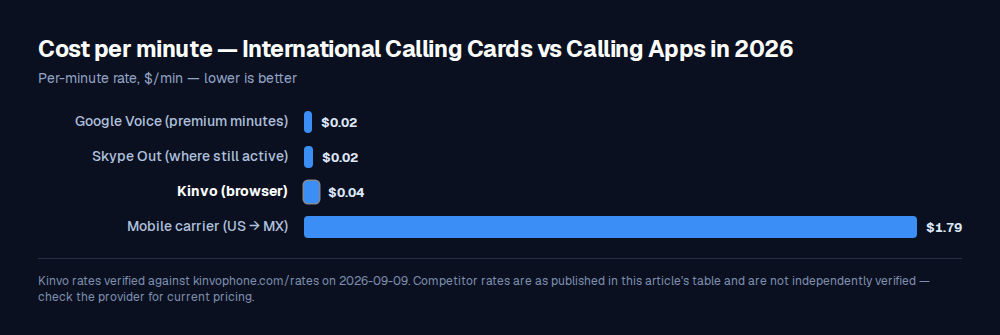
Kinvo lands in the lower-middle of this range. The lowest-cost options on paper (Google Voice, Skype where it still exists) come with constraints — Skype no longer reliably works, Google Voice requires more setup and ties calling to a Google account. The middle of this range is where the actual useful comparisons live, and calling cards consistently lose on it.
How to Stop Using Calling Cards
If you are currently spending $10–20/month on physical calling cards, here is the migration:
- Top up $5 of Kinvo credit — same price floor as buying a calling card, fewer fees.
- Bookmark
app.kinvophone.comor install it as a PWA — opens like an app from your home screen. - Add the numbers you call regularly to your contacts in the app.
- Call from the browser when you would previously have used the card.
Credits do not expire. You do not need to "top up before they run out" or worry about the card going stale. When the balance gets low, you add more.
Bottom Line
Calling cards solved a 1990s problem — affordable prepaid international calling from any landline. In 2026, browser-based calling apps solve that same problem with:
- Lower all-in cost per call
- No expiration
- No connection-fee inflation
- No PIN entry, no access numbers
- Better audio
- Calls placed from any device with a browser
If you are already comfortable with smartphones, this is a straight upgrade with no real downside. The "calling card" category mostly survives now because of habit, retail distribution, and brand recognition — not because the underlying tech still makes economic sense.
Worth trying with $5 of credit. If it does not beat your current calling card on the next 10 minutes of calls to whatever country you are calling, the credit does not expire — you can keep the calling card.
For a deeper provider-by-provider cost comparison, see our cheapest way to call internationally guide, or run the numbers for your specific calling pattern with the call cost calculator.
Ready to start calling?
Sign up and get bonus credits on your first purchase. No app download needed — start calling from your browser in under 60 seconds.
Start CallingFind our guides again — mark Kinvo as a source you trust and Google will surface us more often in your Search, Discover and AI results.
Add Kinvo as a preferred source