
Kinvo vs WhatsApp: Which International Calling Service Is Better?
Last updated: September 2026
TL;DR
These are not really competitors, and pretending otherwise would be dishonest — if the person you are calling has WhatsApp and a working connection, WhatsApp is free and Kinvo cannot beat free. Use it. The gap is everyone else: landlines, offices, clinics, banks, government lines, older relatives on basic handsets, and anyone whose connection is too weak to hold a data call. WhatsApp cannot dial those numbers at all, at any price. Kinvo places an ordinary phone call to any landline or mobile in 218 countries from a browser tab, and the person on the other end needs no app, no smartphone, and no internet. Most people end up using both.
Feature-by-Feature Comparison
| Feature | Kinvo | Edge | |
|---|---|---|---|
| Cost | From $0.04/min + $0.05 on answer | Free | |
| Calls landlines | Yes — 218 countries | No | Kinvo |
| Calls mobiles without the app | Yes | No | Kinvo |
| Recipient needs the app | No | Yes | Kinvo |
| Recipient needs internet | No | Yes | Kinvo |
| App download required | No — browser | Yes — iOS/Android | Kinvo |
| Video calls | No | Yes | |
| Group calls | No | Yes | |
| Messaging | No | Yes | |
| Caller ID on the call | Verified personal number or virtual (US/CA) | Your WhatsApp account | Kinvo |
| Availability restrictions | None — ordinary phone call on the far end | VoIP restricted in the UAE; blocked in China | Kinvo |
| Encryption | Encrypted in transit (WebRTC/SRTP) | End-to-end encrypted | |
| Itemised call costs | Yes, with CSV export | Call history only | Kinvo |
| Team accounts | Yes — shared wallets, spending limits | No (WhatsApp Business is separate) | Kinvo |
| Best for | Reaching anyone with a phone number | People who already use WhatsApp | Tie |
About Kinvo
Kinvo is a browser-based international calling service launched in 2025. It uses WebRTC technology to let users call landlines and mobile phones in 218 countries directly from any modern browser — no app download required. Kinvo operates on a pay-as-you-go credit system with rates starting from $0.04/min for popular destinations like the US and UK. Credits never expire. A $0.05 connection fee is charged only when the call is answered. Kinvo runs on dual-carrier VoIP infrastructure (a primary carrier with automatic failover to a second) for 99.9% uptime. Features include team accounts with shared credit wallets and per-member spending limits, custom caller ID verification, virtual phone numbers in the US and Canada, and a call analytics dashboard with CSV export. All calls use HD voice codecs, encrypted from the browser to the Kinvo network.
About WhatsApp
WhatsApp is Meta's messaging app, with well over two billion users worldwide. Its voice and video calls are free and end-to-end encrypted, and they travel as internet data rather than as phone calls. That is also the limit: a WhatsApp call can only reach another WhatsApp account, so both people need the app installed, registered to a phone number, and online at the time.
Key Differences
- WhatsApp calls reach WhatsApp accounts only; Kinvo dials any landline or mobile number in 218 countries, and the recipient needs nothing installed
- WhatsApp is free; Kinvo is pay-as-you-go from $0.04/min with a $0.05 fee on answered calls
- A WhatsApp call needs both sides online at once; a Kinvo call arrives over the normal phone network, so the recipient needs no internet at all
- WhatsApp calling is blocked or restricted in several countries, including the UAE and China; regular phone calls to those numbers are not affected
- WhatsApp shows your WhatsApp identity; Kinvo can present a verified personal number or a virtual number in the US or Canada
- Kinvo is voice only — calls out to any number, and calls in on a virtual number — with no messaging, video, or group calling
When to Choose Kinvo
- +The person you are calling does not have WhatsApp — a landline, a workplace, a hospital, a bank, a consulate, or a relative on a basic handset. WhatsApp cannot reach any of these
- +Their internet is unreliable — a normal phone call arrives over the mobile network and holds up where a data call breaks apart
- +You are calling a country where WhatsApp calling is blocked or restricted — the UAE restricts VoIP calling and China blocks WhatsApp outright, while an ordinary phone call to those numbers is unaffected
- +You want your own verified number to show as caller ID, so the call is answered rather than ignored as an unknown contact
- +You need it from a work laptop or a device with no app installed — Kinvo runs in a browser tab
- +You need call records, per-call costs, and CSV export for expensing — WhatsApp keeps a history, not an itemised bill
- +You are calling a business that answers a switchboard, where there is no personal account to call
When to Choose WhatsApp
- +The person you are calling already has WhatsApp and a decent connection — the call is free and there is no argument for paying for it
- +You want video calling or group calls, which Kinvo does not offer
- +You want messaging, photos, and voice notes in the same thread as the call
- +You are calling someone you already message on WhatsApp daily — the contact is right there and the call is one tap
Final Verdict
These are not really competitors, and pretending otherwise would be dishonest — if the person you are calling has WhatsApp and a working connection, WhatsApp is free and Kinvo cannot beat free. Use it. The gap is everyone else: landlines, offices, clinics, banks, government lines, older relatives on basic handsets, and anyone whose connection is too weak to hold a data call. WhatsApp cannot dial those numbers at all, at any price. Kinvo places an ordinary phone call to any landline or mobile in 218 countries from a browser tab, and the person on the other end needs no app, no smartphone, and no internet. Most people end up using both.
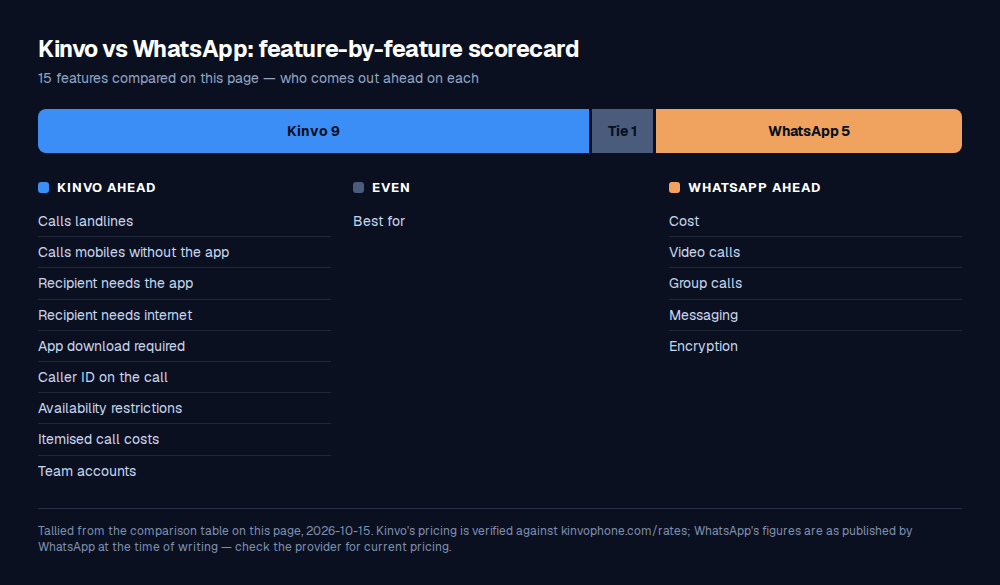
9
Kinvo leads
1
Tied
5
WhatsApp leads
Start Calling
Sign up in 30 seconds to any country. No credit card required. Works in your browser — nothing to download or install.
Other Comparisons
Kinvo vs Yolla
Yolla is an international calling service that launched around 2016, offering pay-as-you-go calls to landlines and mobiles in 190+ countries from rates as low as $0.01/min. It runs as mobile apps (iOS and Android) and a web version, shows your own number as caller ID, and runs occasional welcome offers (e.g. discounted first-minute bundles for specific countries).
Kinvo vs YadaPhone
YadaPhone is a browser-based international calling service founded in 2024 in Vienna, Austria. It offers VoIP calling to 180+ countries with inbound calls, call recording with AI transcripts, and CRM-like contact management.
Kinvo vs Viber Out
Viber Out is the paid calling feature within the Viber messaging app, allowing users to call landlines and mobile phones in 100+ countries. It requires downloading the Viber app and purchasing credits through the app.
Kinvo vs Google Voice
Google Voice is a telephony service by Google that provides a US phone number for calling, texting, and voicemail. The personal version is free for US domestic calls but limited to US availability. Business use requires Google Workspace at $10+/user/month.
Kinvo vs Skype
Skype was a telecommunications application that offered VoIP calling, video conferencing, and messaging. Originally launched in 2003 and acquired by Microsoft in 2011, Skype was officially shut down in May 2025 after years of declining usage. Users were migrated to Microsoft Teams.
Kinvo vs Rebtel
Rebtel is a Swedish international calling service founded in 2006. It uses a "local-leg" technology that routes calls partially over the local PSTN to avoid VoIP quality issues, and is available via mobile app and web. Rebtel targets diaspora users calling family abroad, with subscription bundles for unlimited minutes to specific countries.
Kinvo vs RingCentral
RingCentral is a cloud-based business phone system (UCaaS) founded in 1999, offering VoIP phone service, video conferencing, and team messaging. It targets small businesses through enterprise with seat-based subscriptions starting at $30/user/month. RingCentral is a full PBX replacement with phone numbers, extensions, IVR, call queues, and CRM integrations.
Kinvo vs Traditional Calling Cards
Traditional calling cards (also called phone cards or prepaid calling cards) are a pre-internet method of making international calls. Users dial an access number, enter a PIN, then dial the destination. They are sold at convenience stores, gas stations, and online.
Kinvo vs T-Mobile international calling
T-Mobile sells international calling from the US as an add-on to an existing postpaid line. Stateside International Talk is $15/month and covers unlimited calls from the US, Mexico or Canada to landlines in 70+ countries and mobiles in 30+ countries. Without the add-on, calls fall back to per-minute pay-per-use rates that vary by destination — T-Mobile's own rate chart lists Canada at $1.00/min, with many destinations higher. (Checked August 2026.)
Kinvo vs Verizon international calling
Verizon sells international calling from the US in three shapes. Standard Pay Per Minute has no monthly charge and, in Verizon's words, has "rates starting from $0.49/min". Global Calling Plus is $15/month for unlimited calls to landlines in 60+ countries and mobiles in 30+, with discounted calls to a further 160+ countries starting at $0.05/min. Global Choice is $10/month for up to 300 minutes to a single country of your choice. (Checked August 2026.)
Kinvo vs AT&T international calling
AT&T sells International Calling as a monthly add-on to a wireless line: $15/month per device for unlimited calls from the US to 85+ countries plus discounted rates to 140+ more, or $10/month for 250 minutes to 70 countries. Without a package, calls bill at pay-per-use rates — from about $1/min to Mexico and Canada and up to roughly $3/min to other destinations. (Checked August 2026.)